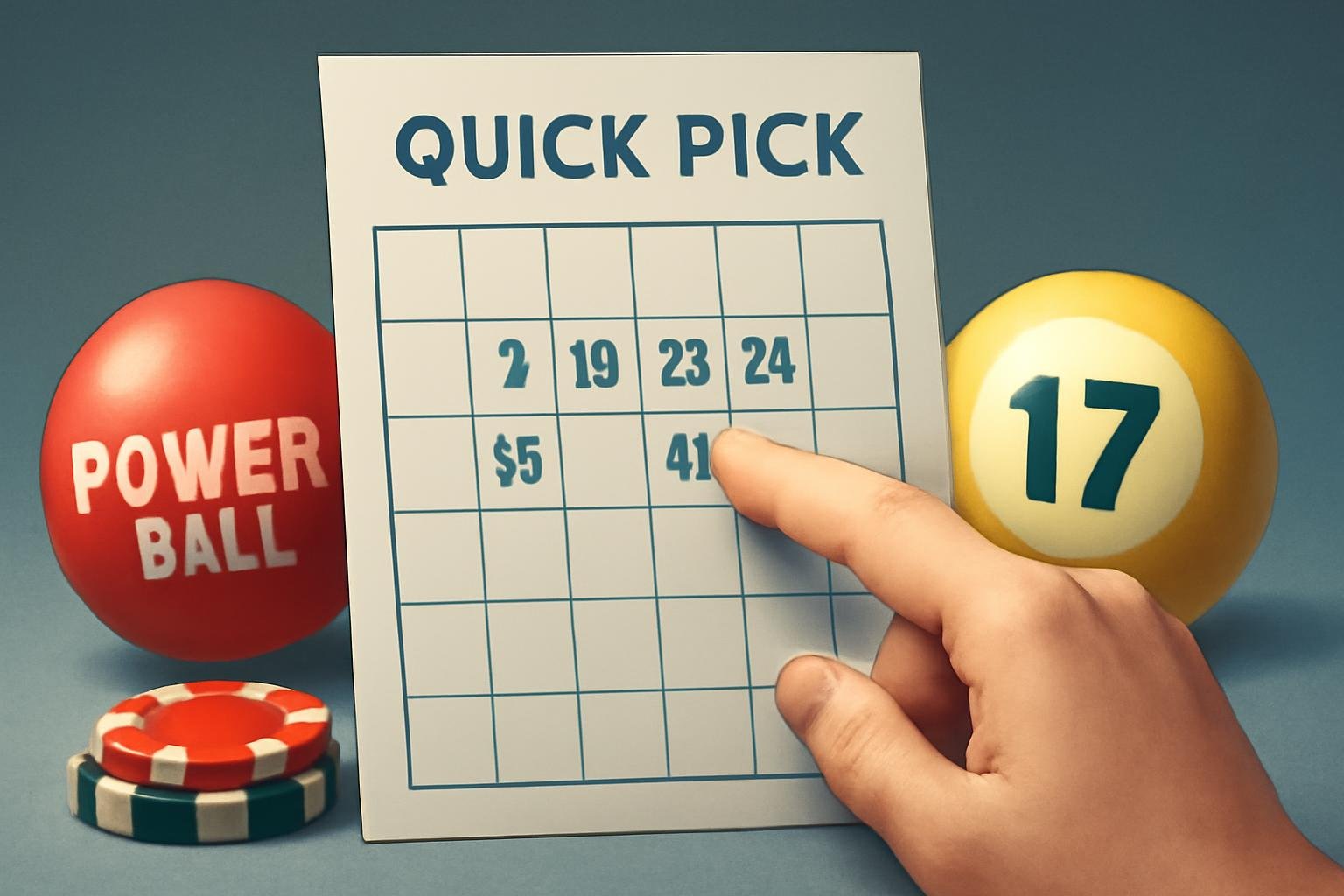
Picking lottery numbers can turn a simple decision into a surprisingly long one. Some people reach for birthdays, while others look through previous results or try to balance odd and even numbers. Quick Pick offers another approach: let a lottery terminal choose the numbers randomly.
The useful question is what this changes. It removes the need to choose a line yourself, but it does not give that line a special mathematical advantage. Understanding that distinction makes it easier to assess both official Quick Pick entries and independent number-selection resources.
What does a Powerball Quick Pick select?
A standard Powerball line consists of five distinct white-ball numbers from 1 to 69 and one red Powerball number from 1 to 26. The red ball comes from a separate pool, so its number can also appear among the five white-ball numbers.
If you are comparing ways to select a line, the powerball quick pick page on Lottery Toolbox is a related resource to explore. A website showing a combination is separate from an official lottery purchase; displayed numbers alone do not enter a drawing.
Does random selection improve the odds?
For a fair Powerball drawing, every valid combination has the same chance of matching the jackpot numbers. A manually selected line and a randomly selected line therefore have equal jackpot odds: 1 in 292,201,338 per play under the current game format.
The U.S. prize chart lists the overall chance of winning any prize as about 1 in 24.87. That figure includes smaller prizes, so it should never be confused with the chance of winning the jackpot. It also does not mean that playing 25 times guarantees a prize.
A number’s appearance in an earlier drawing does not make it due in the next one. Replacing a line because it looks unlucky, or repeatedly generating new lines until one feels right, changes your selection process rather than the probability attached to the final line.
Why unusual-looking lines are still valid
A line with adjacent numbers may look less convincing than one spread neatly across the available range. However, any particular valid line has the same jackpot probability as any other. There are many more combinations with mixed patterns than there are with one specific pattern, but that does not make your individual mixed-pattern ticket more likely to win.
For example, 1, 2, 3, 4 and 5 with Powerball 6 is a valid combination. So is 8, 19, 34, 52 and 67 with Powerball 14. Neither specific line becomes more likely merely because its numbers look more random. These are illustrations, not suggested selections.
Keep number selection separate from ticket checks
When reviewing an entry, focus on details that affect whether it is valid for the drawing you intended:
- Check that the five white-ball numbers are distinct and within the correct range.
- Keep the red Powerball separate when copying or checking a line.
- Confirm the drawing date on an actual purchased ticket.
- Use official lottery results and validation procedures when checking a ticket.
Quick Pick saves you the task of choosing a line. Its value is convenience, and the numbers it produces still face the same odds. Whether you choose numbers yourself or use random selection, treat the result as a game of chance and keep any spending within a limit set in advance.